Quick answer
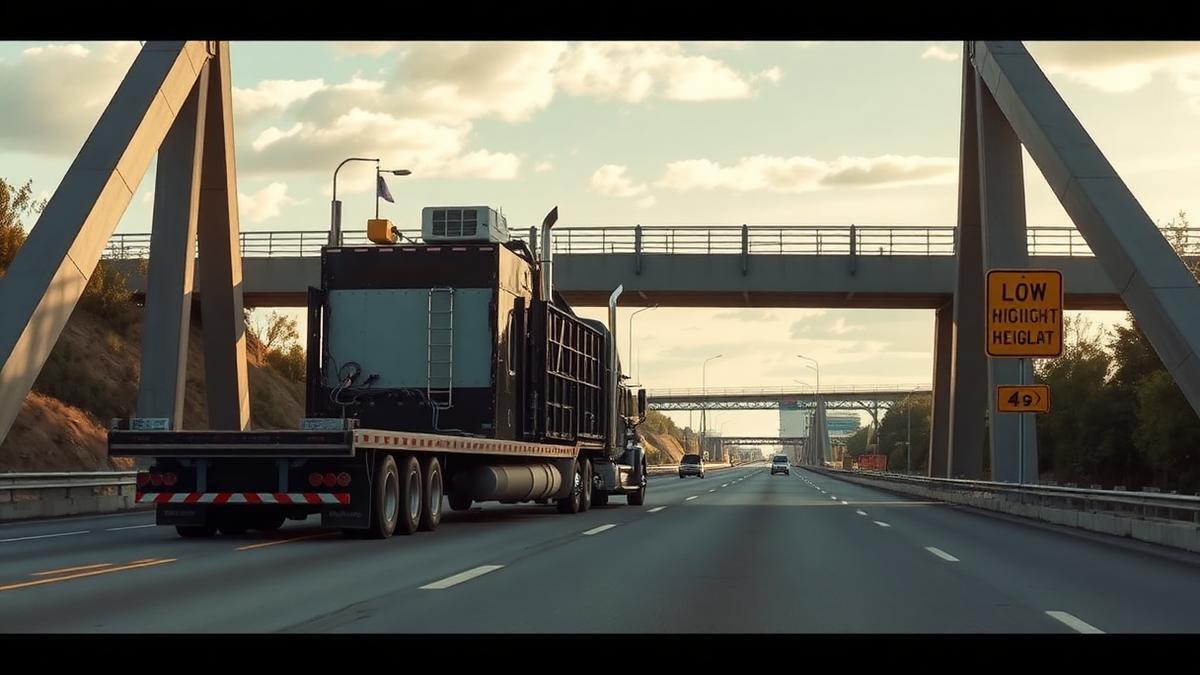
A step deck trailer sits about 40 inches off the ground on the lower deck, so a load up to roughly 10 feet 2 inches tall stays inside the 13 feet 6 inch legal height limit used by most US states. Dispatchers plan tall-load routes by measuring true loaded height, adding a safety buffer of at least 6 inches, running the route through truck-specific mapping with verified bridge clearance data, and pulling an oversize height permit from every state crossed when the load exceeds that state's legal limit.
Key takeaways
- Legal height is 13 feet 6 inches in most states; 14 feet is allowed in several western states.
- Step deck lower decks sit around 36-42 inches high, giving roughly 10 feet of usable cargo height.
- Always measure the loaded trailer with a height stick — never trust the shipper's stated dimensions.
- Add a 6-inch buffer for tire pressure, suspension settling, road crown, and repaved surfaces.
- Permits are per-state, route-specific, and often carry curfews and daylight-only travel rules.
Why step deck clearance is the number one route risk
A bridge strike is not a fender bender. It is a destroyed load, a closed highway, a state DOT damage claim that can run into six figures, and an out-of-service order that follows your MC number. For step deck and lowboy carriers hauling machinery, HVAC units, crated equipment and building materials, height is the constraint that ends careers fastest.
The frustrating part is that almost every strike is preventable. It happens because someone trusted a stated dimension, used a car GPS, or assumed a road that cleared last year still clears after repaving.
Step deck height math: how much cargo height do you really have?
A step deck (also called a drop deck) exists precisely to buy you height. The lower deck sits roughly 36 to 42 inches off the ground versus about 60 inches on a standard flatbed, which is why an 8 to 10 foot tall machine that would be oversize on a flatbed rides legal on a step deck.
- Deck height varies with tire size, suspension type and air ride settings — measure your own trailer, do not use a spec sheet.
- Loaded suspension squat and dunnage under the cargo both change the final number.
- If the math puts you within 6 inches of legal, treat the load as oversize and plan accordingly.
| Trailer type | Typical deck height | Legal cargo height at 13'6" |
|---|---|---|
| Standard flatbed | 60 in (5 ft) | ~8 ft 6 in |
| Step deck / drop deck | 40 in (3 ft 4 in) | ~10 ft 2 in |
| Double drop / lowboy | 18-24 in | ~11 ft 6 in – 12 ft |
| RGN (removable gooseneck) | 18-22 in | ~11 ft 8 in – 12 ft |
State height limits are not uniform
Most of the United States uses a 13 feet 6 inch legal maximum height. A block of western states allows 14 feet, which is why a load can be perfectly legal in Utah and illegal the moment it crosses into a 13'6" state.
- 13 ft 6 in: the majority of eastern, midwestern and southern states, including Texas, Illinois, Ohio, Georgia and Pennsylvania.
- 14 ft: several western states such as Colorado, Nevada, Arizona, New Mexico, Oklahoma, Utah and Wyoming.
- Above the state limit: an oversize height permit is required from each state on the route, and each permit approves a specific routing.
- City and county roads can have lower posted structures than the state limit — a legal-height load can still strike a local underpass.
How dispatchers actually map a tall-load route
Route planning for a tall load is a sequence, not a search. This is the workflow a professional step deck dispatcher runs before the driver ever books the load.
- Confirm the real loaded height with a height stick after the load is secured — never from the shipper's paperwork alone.
- Add the safety buffer: 6 inches minimum for suspension settling, tire pressure, road crown and recent repaving.
- Run the route in truck-specific routing software with dimension inputs, not consumer GPS.
- Cross-check every flagged structure against the state DOT bridge clearance database and posted low-clearance lists.
- Identify the pinch points — old rail underpasses, tunnels, urban viaducts, covered scales and toll plazas — and build a legal detour around each one.
- Verify the first and last mile: shipper and receiver yards, gate canopies, fuel islands and overhead wires are where many strikes actually happen.
- If any state on the route needs a permit, apply for it and route the truck strictly on the permitted path.
When you need a height permit — and what it costs you in time
An oversize height permit is not just a fee. It is a set of operating restrictions that change the economics of the load, and the dispatcher has to price those restrictions into the rate before saying yes.
- Permits are issued per state and are route-specific; a reroute usually means a new permit.
- Typical single-trip permit fees run roughly $15 to $100 per state, with higher fees for superloads.
- Travel is often limited to daylight hours, with curfews around weekends, holidays and metro rush periods.
- Loads over about 14 feet 6 inches frequently require a height-pole escort vehicle, adding a per-mile escort cost.
- Permit lead time can range from same-day to several business days depending on the state and the height.
The tools and data sources that keep tall loads legal
- Truck-specific routing platforms that accept height, weight, length and hazmat inputs.
- State DOT oversize/overweight portals for permits and posted route restrictions.
- Published state low-clearance and bridge strike lists, which flag chronically struck structures.
- Live construction and lane-closure feeds — a detour off a permitted route is where clearance disappears.
- Driver-reported intel: the carrier network's own notes on tight yards, low canopies and bad exits.
How Fifth Wheel Dispatch handles step deck and tall freight
We treat height as a booking condition, not an afterthought. Before a step deck load is confirmed, we verify the loaded dimensions with the driver, map the route around every known low structure, confirm whether a permit is required in each state crossed, and negotiate the rate with permit fees, escort costs and daylight-only curfews already priced in.
That means the driver gets a routed, permitted, profitable load instead of a cheap rate that turns into a claim. We dispatch step deck, flatbed, RGN, lowboy and heavy haul across all 48 states.
Frequently asked questions
How tall can a load be on a step deck trailer?
With a typical 40-inch lower deck, a step deck can carry cargo about 10 feet 2 inches tall and stay under the 13 feet 6 inch legal height limit used in most states. In 14-foot states you gain roughly another 6 inches of legal cargo height.
What is the legal height limit for trucks in the United States?
There is no single federal height limit. Most states cap total vehicle height at 13 feet 6 inches, while several western states including Colorado, Nevada, Arizona, New Mexico, Oklahoma, Utah and Wyoming allow 14 feet.
Do I need a permit for an over-height load?
Yes. If the loaded height exceeds a state's legal maximum, you need an oversize height permit from that state, and permits are route-specific. You need one from every state your route crosses, and the truck must stay on the approved routing.
How do dispatchers avoid low bridges?
They route with truck-specific software using the actual loaded height plus a safety buffer, cross-check flagged structures against state DOT bridge clearance data, avoid known low-clearance corridors, and confirm the first and last mile into the shipper and receiver yards.
How much buffer should I add to my measured height?
At least 6 inches. Tire pressure, air suspension settling, road crown, load shift and repaved road surfaces all change effective clearance, and posted bridge heights are not always current after resurfacing.
What happens if a truck hits a bridge?
Expect load damage, state DOT structural damage claims that can reach six figures, citations, insurance consequences and a compliance record that affects your CSA scores and future broker relationships.
Want this handled for you instead?
Fifth Wheel Dispatch LLC dispatches owner-operators and small fleets across all 48 states — 13 equipment types, dedicated dispatchers, rate negotiation on every load, and full paperwork support. Standard 5%, fleet 4%, or hybrid at $49.99 per truck plus 3.5% weekly.
Keep reading
Brokers post a rate expecting a counter. Here is the data to gather before you call, the exact language to use, and how to hold your number without losing the load.
Own a semi-tractor but no trailer? Power-only dispatch services let you haul pre-loaded trailers, skip trailer overhead, and run drop-and-hook freight across the United States.
Every empty mile costs you the same fuel, tires, and hours as a loaded one — with zero revenue. Here is how to get deadhead under 8% and what that is worth annually.