Quick answer
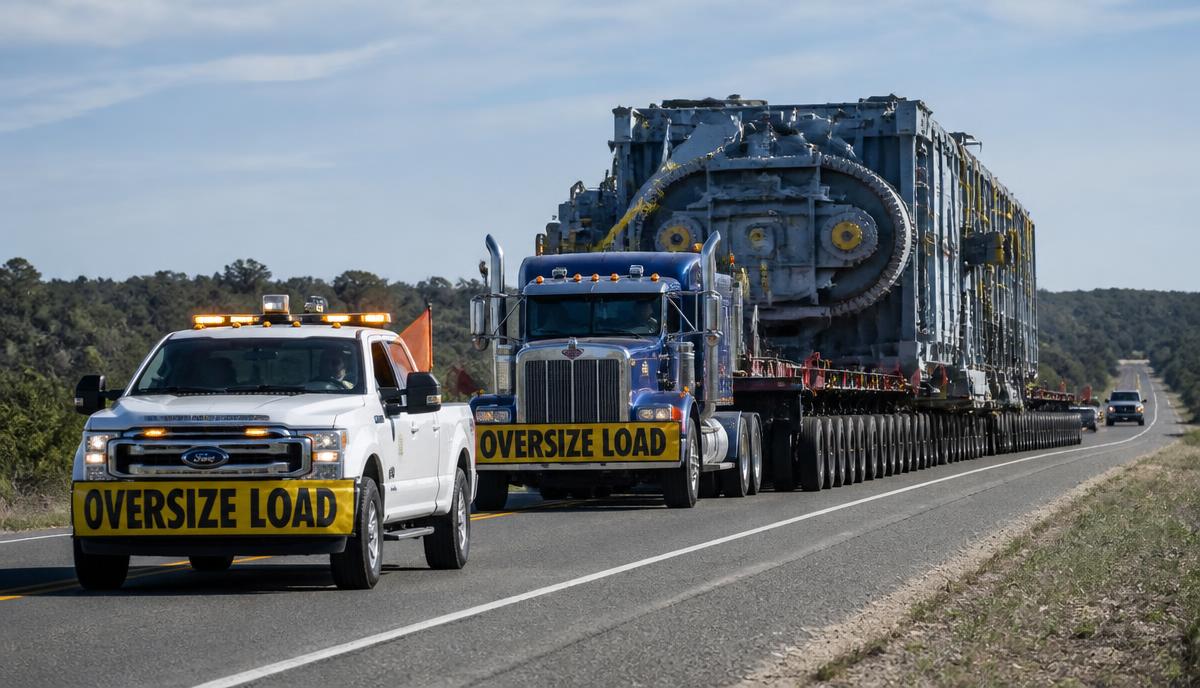
A load is oversize once it exceeds any state legal limit — typically 8 feet 6 inches wide, 13 feet 6 inches tall, 80,000 lbs gross, or the state length limit — and it becomes a superload when it exceeds the state's permit-by-right ceiling (commonly around 16 feet wide, 16 feet tall, 150,000 lbs, or 120 feet long), which triggers engineering review and a route survey. Pilot cars are generally required at 12 feet wide on two-lane roads, 14 feet wide on divided highways, and for over-height loads a height-pole car is required; police escorts and utility escorts are added at the widest and tallest thresholds. Permits are route-specific, cost roughly $15 to $1,000+ per state, and superload permits can take 5 to 30 business days.
Key takeaways
- Every state writes its own oversize rules — one trip across five states means five permits and five sets of curfews.
- Pilot car triggers cluster around 12 feet wide (two-lane), 14 feet wide (divided highway) and any over-height load needing a height pole.
- Superloads are not just bigger permits: expect engineering review, bridge analysis, a route survey and multi-week lead time.
- Price permits, escorts at $1.75–$3.00 per mile per car, daylight-only curfews and dead days into the rate before you accept the load.
- Never move off the permitted route. A detour voids the permit and shifts every dollar of liability onto the carrier.
When a load becomes oversize — and when it becomes a superload
Federal law sets minimums on the Interstate system, but permitting is a state function. A load is legal until it exceeds a state's dimensional or weight limit; past that point it needs an oversize/overweight (OS/OW) permit. Past a second, higher threshold it becomes a superload, which is reviewed by state engineers rather than issued over the counter.
The practical takeaway for an owner-operator: your loaded dimensions decide your paperwork, your escort bill, your driving hours and your rate. Measure before you quote, not after you load.
| Dimension | Typical legal limit | Permit range | Superload territory |
|---|---|---|---|
| Width | 8 ft 6 in | 8 ft 7 in – 16 ft | Over ~16 ft |
| Height | 13 ft 6 in (14 ft in many western states) | Up to ~16 ft | Over ~16 ft |
| Length | 48–53 ft trailer / 65–75 ft combined | Up to ~120 ft | Over ~120 ft |
| Gross weight | 80,000 lbs | 80,001 – 150,000 lbs | Over ~150,000 lbs |
Pilot car and escort thresholds you can plan around
Escort rules vary by state, but the trigger points repeat often enough to budget against. Confirm each state on the permit itself — the permit is the legal authority, not a rule of thumb.
- 12 feet wide on two-lane undivided highways — usually one pilot car, often front on two-lane and rear on multi-lane.
- 14 feet wide on divided highways — usually one car; many states go to two cars (front and rear) at 16 feet.
- Over-height loads — a lead car with a calibrated height pole set a few inches above the load height.
- Extreme width, length or weight — police escort, and sometimes a utility company escort to lift or de-energize lines.
- Long loads (typically 100–120 ft) — rear escort for lane changes and merges regardless of width.
How states differ in practice
These are the differences that break schedules: not the limits themselves, but the curfews, seasonal restrictions and travel-time rules layered on top of them.
- Height: most states cap at 13 ft 6 in, but Colorado, Nevada, Arizona, New Mexico, Oklahoma, Utah and Wyoming allow 14 ft — a route through them may avoid a permit entirely.
- Weekend and holiday travel: some states allow Saturday movement, others stop oversize traffic from Friday evening to Monday morning, and nearly all shut down for major holidays.
- Metro curfews: no movement through major urban areas during rush hours, which reshapes where your driver must overnight.
- Daylight-only rules: most oversize permits limit travel to sunrise-to-sunset, cutting usable driving hours in winter.
- Seasonal limits: frost laws in northern states lower weight limits in spring thaw; some states restrict wide loads during harvest or construction season.
- Permit validity: single-trip permits usually run 3 to 10 days; annual permits exist for milder oversize but rarely cover superloads.
What oversize moves actually cost
Ranges below are planning figures for budgeting a quote. Actual fees depend on the state, the axle configuration and the routing.
| Cost item | Typical range | Notes |
|---|---|---|
| Single-trip OS permit | $15 – $100 per state | Higher with weight and dimensions |
| Superload permit | $150 – $1,000+ per state | Includes engineering and bridge review |
| Pilot car | $1.75 – $3.00 per mile per car | Plus minimum day rates and deadhead |
| Police escort | $50 – $125 per hour | Often billed with a minimum and travel time |
| Route survey | $300 – $2,500 | Common on superloads; utility work billed separately |
| Dead days / curfews | Lost revenue | Weekend and holiday shutdowns must be in the rate |
The dispatcher's oversize workflow, step by step
- Confirm real loaded dimensions and axle weights with the driver — never trust the broker's estimate.
- Build a candidate route and identify every state crossed plus every bridge, tunnel and low structure on it.
- Check each state's limits to decide permit vs superload, and price escort requirements per state.
- File permits with correct routing and start superload applications early — engineering review is the schedule driver.
- Book pilot cars along the corridor and confirm they hold current state certifications where required.
- Map legal overnight parking that fits daylight-only and curfew windows.
- Negotiate the rate with permits, escorts, curfews and dead days included, then send the driver a written permit and routing packet.
Mistakes that turn a good oversize rate into a loss
- Quoting before measuring — 2 extra inches of width can add a pilot car for the entire trip.
- Accepting an all-in rate and discovering the carrier owes the permits and escorts.
- Deviating from the permitted route for fuel, food or traffic, which voids the permit.
- Ignoring escort deadhead and minimum day rates when a car has to travel to the origin.
- Forgetting flags, banners, lights and marker requirements — a cheap citation at a scale house.
- Planning normal daily mileage on a daylight-only permit and missing the delivery window.
How Fifth Wheel Dispatch handles oversize and heavy haul
We dispatch flatbed, step deck, RGN, lowboy and heavy haul across all 48 states, and we treat permits and escorts as part of the rate, not a surprise. Before a load is confirmed we verify dimensions, plan the routing state by state, identify permit and escort requirements, and negotiate so the fees, escort miles and curfew days are covered.
If you run oversize freight and want the permit paperwork, routing and rate negotiation handled for you, call +1 (872) 255-5130 or email info@fifthwheeldispatch.com.
Frequently asked questions
What is considered an oversize load?
Any load exceeding a state's legal limits — commonly 8 feet 6 inches wide, 13 feet 6 inches tall, the state length limit, or 80,000 lbs gross. Exceeding any single limit makes the move oversize and requires a permit from every state on the route.
What is a superload?
A superload exceeds the dimensions or weight a state will permit routinely — often around 16 feet wide, 16 feet tall, 120 feet long or 150,000 lbs. Superloads require engineering and bridge review, usually a route survey, and lead times of roughly 5 to 30 business days.
When is a pilot car required?
Generally at about 12 feet wide on two-lane undivided highways and 14 feet wide on divided highways, with a second car at greater widths, plus a height-pole car for over-height loads and a rear escort for very long loads. The exact trigger is stated on each state's permit.
How much does an oversize permit cost?
Single-trip oversize permits typically run about $15 to $100 per state, while superload permits commonly cost $150 to $1,000 or more per state because they include engineering review and bridge analysis.
How much do pilot cars cost per mile?
Budget roughly $1.75 to $3.00 per mile per pilot car, plus minimum day rates and deadhead miles to reach the origin. Police escorts are usually billed hourly at about $50 to $125 per hour.
Can oversize loads travel at night or on weekends?
Usually not. Most oversize permits restrict travel to daylight hours, and many states prohibit movement on weekends and holidays or through major metro areas during rush hours. Those restrictions are printed on the permit and must be planned into the schedule.
What happens if you leave the permitted route?
The permit becomes invalid. The carrier is then running an illegal oversize movement and is exposed to citations, out-of-service orders, denied insurance coverage and full liability for any bridge or utility damage.
Who pays for permits and escorts — the carrier or the broker?
It depends entirely on the rate confirmation. Some rates are all-in with the carrier paying permits and escorts; others reimburse them separately. Always confirm in writing before accepting, because escort miles alone can exceed the linehaul margin.
Want this handled for you instead?
Fifth Wheel Dispatch LLC dispatches owner-operators and small fleets across all 48 states — 13 equipment types, dedicated dispatchers, rate negotiation on every load, and full paperwork support. Standard 5%, fleet 4%, or hybrid at $49.99 per truck plus 3.5% weekly.
Keep reading
One low bridge can end a career. Here is exactly how professional dispatchers calculate step deck clearance, route around obstructions, and decide when a height permit is actually required.
Brokers post a rate expecting a counter. Here is the data to gather before you call, the exact language to use, and how to hold your number without losing the load.
Own a semi-tractor but no trailer? Power-only dispatch services let you haul pre-loaded trailers, skip trailer overhead, and run drop-and-hook freight across the United States.