Quick answer
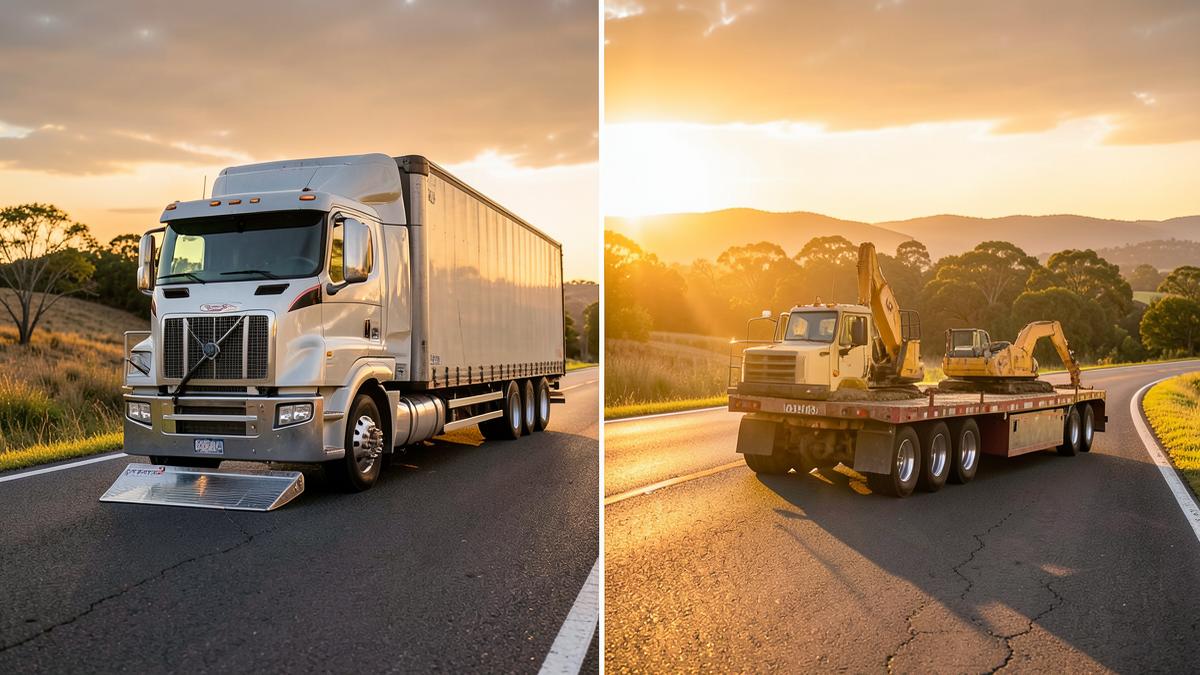
A Removable Gooseneck (RGN) trailer has a detachable front neck that folds down into a ramp, letting you load heavy equipment like excavators and dozers from the front without using a crane. A traditional fixed-neck lowboy has a permanent gooseneck, usually sits lower, carries taller loads legally, and is cheaper to buy, but it needs a dock, crane, or ramps for loading. Use an RGN when you need ground-loading flexibility and faster self-loading; choose a fixed-neck lowboy when the load is extremely tall or heavy and can be loaded with a crane.
Key takeaways
- RGN trailers ground-load equipment via a detachable ramp; fixed-neck lowboys need cranes, docks, or auxiliary ramps.
- Fixed-neck lowboys typically sit 2-6 inches lower than RGNs, giving more legal cargo height before permits.
- RGNs speed up loading/unloading in remote job sites; lowboys excel at superload height and weight.
- Permit and escort costs depend on total dimensions, not trailer type alone.
- Fifth Wheel Dispatch matches RGN and lowboy loads with route, permit, and escort planning across all 48 states.
What is an RGN trailer?
An RGN trailer is a type of lowboy where the front gooseneck can be detached and lowered to create a ramp. This allows machinery to drive or roll onto the trailer from the front at ground level.
- Detachable gooseneck converts into a loading ramp
- Front loading at ground level — no crane required for many machines
- Common deck heights around 18-24 inches
- Ideal for excavators, dozers, loaders, and tracked equipment
What is a fixed-neck lowboy?
A fixed-neck lowboy has a permanent gooseneck that cannot be removed. Equipment is usually loaded from the rear using ramps, a dock, or a crane. The fixed neck often allows the trailer to sit slightly lower than an RGN.
- Permanent gooseneck keeps the trailer in one rigid configuration
- Typically lower deck height, often 16-20 inches
- Best for very tall or very heavy superloads where every inch of height matters
- Usually cheaper to purchase and maintain than a comparable RGN
RGN vs Lowboy side-by-side comparison
The decision between an RGN and a lowboy comes down to four things: how the machine gets on the trailer, how low the deck sits, what the load weighs, and where the load is being picked up.
| Factor | RGN trailer | Fixed-neck lowboy |
|---|---|---|
| Loading method | Detachable ramp from front | Rear ramps, crane, or dock |
| Typical deck height | 18-24 inches | 16-20 inches |
| Best cargo height at 13'6" | Up to ~11 ft 6 in | Up to ~12 ft |
| Self-loading in remote areas | Yes — drive-on from front | No — needs external equipment |
| Purchase cost | Higher | Lower |
| Maintenance | More moving parts | Simpler, fewer parts |
| Ideal freight | Excavators, dozers, tracked loaders | Tall tanks, heavy superloads, large machinery |
| Permit complexity | Same as lowboy by dimensions | Same as RGN by dimensions |
When to choose an RGN
Use an RGN when the job site or receiver does not have a crane, when you need to load or unload quickly, or when the cargo is self-propelled tracked equipment.
- Remote construction sites without crane support
- Frequent equipment changes where fast loading saves labor hours
- Tracked machinery that can drive onto the deck under its own power
- Loads where the slight height penalty is acceptable for loading convenience
When a fixed-neck lowboy is the better bet
Choose a fixed-neck lowboy when the load is extremely tall or heavy, and when every inch of legal height matters to avoid a costly oversize permit.
- Superloads that push state height limits
- Loads that require the lowest possible center of gravity
- Operations with crane access at both origin and destination
- Carriers who want lower equipment cost and simpler maintenance
Permits, escorts, and route planning for both trailer types
The trailer choice does not change the permitting rules. What matters is the total width, height, length, and weight once the machine is loaded. A good dispatcher treats the trailer as one input into a much larger route and permit plan.
- Measure the loaded height with a height stick, not the shipper's estimate
- Add 6 inches of clearance buffer for suspension, road crown, and repaving
- Secure route-specific permits from every state crossed
- Arrange pilot cars and police escorts based on state thresholds
- Use truck-specific routing with bridge clearance data
How dispatchers price RGN and lowboy loads
Heavy-haul rates must account for more than linehaul. A good dispatcher prices the permit, escort, fuel, loading time, and reload potential into the negotiation before the carrier ever accepts the load.
- Linehaul rate per loaded mile
- Permit fees per state
- Pilot car and escort costs per mile and per day
- Loading and unloading detention risk plus scheduling windows
- Deadhead miles and reload difficulty after delivery
Fifth Wheel Dispatch for RGN and lowboy carriers
We work with heavy-haul owner-operators and small fleets running RGN, lowboy, step deck, and flatbed equipment. Our dispatchers handle the dimensions, permits, escorts, and rate negotiation so you can focus on safe loading and driving.
Call +1 (872) 255-5130 or email info@fifthwheeldispatch.com to talk through your next heavy-haul move.
- Route and clearance planning for tall and wide loads
- Permit coordination across all 48 states
- Escort and pilot car scheduling
- Rate negotiation that covers permit, escort, and deadhead costs
Frequently asked questions
What does RGN stand for in trucking?
RGN stands for Removable Gooseneck. It is a type of lowboy trailer where the front neck can be detached and used as a ramp for loading.
Is an RGN the same as a lowboy?
An RGN is a type of lowboy. The term lowboy refers to any low-deck trailer; RGN specifically means the gooseneck is removable for ground-level loading.
Which can carry taller loads, RGN or lowboy?
Fixed-neck lowboys often sit 2-6 inches lower, so they can legally carry slightly taller cargo before needing an over-height permit.
Can you load an RGN without a crane?
Yes. That is the main advantage. The detachable neck becomes a ramp so many machines can drive or roll onto the deck from ground level.
Are RGN trailers more expensive than lowboys?
Generally yes. RGNs cost more upfront and have more moving parts, but they save loading time and equipment rental costs on job sites without cranes.
Do RGN and lowboy loads need the same permits?
Permits depend on the loaded dimensions and weight, not the trailer type. Both need route-specific oversize or overweight permits when limits are exceeded.
Want this handled for you instead?
Fifth Wheel Dispatch LLC dispatches owner-operators and small fleets across all 48 states — 13 equipment types, dedicated dispatchers, rate negotiation on every load, and full paperwork support. Standard 5%, fleet 4%, or hybrid at $49.99 per truck plus 3.5% weekly.
Keep reading
Anything over 8'6" wide, 13'6" tall, 53' long or 80,000 lbs needs a permit — and past certain thresholds it needs pilot cars, police escorts and a route survey. Here is how the rules actually work, state by state.
One low bridge can end a career. Here is exactly how professional dispatchers calculate step deck clearance, route around obstructions, and decide when a height permit is actually required.
Brokers post a rate expecting a counter. Here is the data to gather before you call, the exact language to use, and how to hold your number without losing the load.
Own a semi-tractor but no trailer? Power-only dispatch services let you haul pre-loaded trailers, skip trailer overhead, and run drop-and-hook freight across the United States.